
Accessibility: An Opportunity to Innovate
Summary
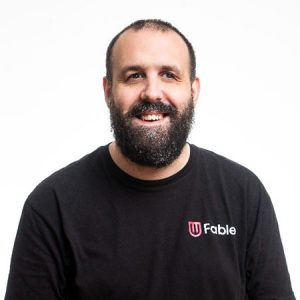
Many organizations struggle with justifying and prioritizing accessibility. One of the primary reasons is because they’re thinking about accessibility all wrong. Instead of a checklist, a list of legal requirements, or a set of shackles holding designers and developers back, it’s time to start thinking of accessibility as what it is: an opportunity to innovate! In this presentation, Fable will draw from our expertise helping organizations like yours start the accessibility journey, to change the way you think about disability, assistive technology, and accessibility. We will demonstrate that accessible products are more flexible, customizable, and useful for all users. We’ll also show you how accessibility is directly tied to the creation of many of the most exciting and innovative technologies of the last 50 years, and how it’s changed the entire world for everyone. This presentation will inspire you with the information and ideas you need to accelerate your accessibility journey.
Key Insights
-
•
Features like dark mode and voice assistants started as accessibility tools but are now mainstream innovations.
-
•
Disability includes permanent, temporary, and situational states, all requiring accessible design.
-
•
Accessible design benefits everyone, including future selves as we age and face new challenges.
-
•
Diverse teams build products that better address a wide range of user needs.
-
•
Accessibility should be integrated early in design to avoid costly retrofitting.
-
•
Compliance checklists alone lead to bare minimum solutions, while inclusive design focuses on great experiences.
-
•
Myths about inaccessible new design paradigms have historically been proven wrong through flexibility.
-
•
Innovation often arises from solving edge cases, exemplified by accessible features becoming broadly useful.
-
•
Involving people with disabilities in product testing and design unlocks unique insights and usability.
-
•
Cultural and linguistic diversity in teams and design research is key to truly inclusive products.
Notable Quotes
"Nothing about us without us."
"When you design for the edges you get the middle for free."
"Accessibility is a process, not a project."
"Disability is a normal part of the human experience."
"If we create inaccessible products, we are locking out our future selves."
"Accessibility requires flexible designs, not limited or simplified designs."
"The electric toothbrush started as an accessibility solution but became better for everyone."
"Diverse teams create diverse products because we each only understand our own needs."
"Compliance is a framework, not just a checklist to tick off."
"Including people with disabilities from day one builds a strong accessible foundation."
Or choose a question:












More Videos

"Leaders have the additional responsibility to create space for conversations."
Nick CochranGrowing in Enterprise Design through Making Connections
June 20, 2019

"85% of Netflix users opt for captions, showing how accessibility features benefit everyone, not just those with disabilities."
Amber KnablEmpowering innovation: The critical role of inclusive product development in the AI era
June 4, 2024

"The biggest learning is it’s about understanding the people and organization beyond just the design team."
Nora Tejeda Giovanna AlonsoScaling Design Capabilities at BBVA Through a Self-service Design Model
June 10, 2021

"You wouldn’t use design thinking to optimize inventory—you use Six Sigma."
Nathan ShedroffRedefining Value: Bridging the Innovation Culture Divide
May 14, 2015

"Scaling design in an enterprise is like having more feet in the car — it gets you there faster."
Lona MooreScaling Design Beyond Designers
June 11, 2021

"Difficult people change things by looking at the world not as it is, but as they hope it could and should be."
Jemma AhmedTheme 2 Intro
March 26, 2024

"Design is not about one brilliant idea but about collaboration between different roles and expertise."
Sabrina Mach Nina WainwrightHow to Design Your Design Operating Model
September 29, 2021

"Content is created all over and inconsistently; leadership needs to see content as the fuel driving the experience."
Kevin M. HoffmanTheme 2: Enterprise Team Journey
June 3, 2019

"Sponsor sessions may require registration by email to prevent Zoom bombings and protect session integrity."
Bria Alexander Louis RosenfeldWelcome
January 8, 2024
Latest Books All books









Dig deeper with the Rosenbot
What are best practices for engaging C-suite executives and physicians as champions for B2B healthcare apps?
Why is prior authorization such a persistent problem and how can patient-centered solutions be designed around it?
How does democratized research impact decision quality and team collaboration?