
To Boldly Go: The New Frontiers of Accessibility
Summary
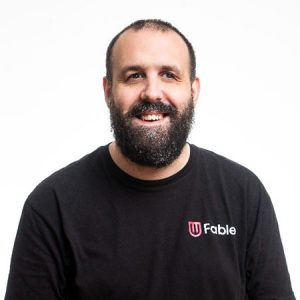
The metaverse, virtual reality, Web 3.0, distributed infrastructure, the Internet of Things, wearable computing, and AI: all these things are going to change the face of accessibility over the next 10 years. In this talk, Samuel Proulx, Fable’s Accessibility Evangelist, will give you an overview of what the current landscape looks like at the frontier of accessibility and assistive technology. Where’s the research taking us? What might be coming down the pipe?
Key Insights
-
•
Early accessibility technologies like the IBM 3767 Braille terminal were expensive and rare, limiting access to a few pioneering users like Sam’s father.
-
•
Hardware text-to-speech systems such as the Echo2 card on Apple II were foundational but costly and limited to command-line interfaces.
-
•
The transition from command-line to graphical user interfaces with Windows 95 introduced major accessibility challenges requiring new techniques for screen readers to interpret visual content.
-
•
Software text-to-speech synthesis replaced expensive hardware devices as PCs grew powerful, enabling more portable and accessible computing devices.
-
•
Assistive technology industry consolidation occurred due to the increasing complexity of accessibility needs post-GUI, exemplified by mergers forming companies like Freedom Scientific.
-
•
Apple’s introduction of built-in VoiceOver on iPhone 3GS marked a paradigm shift by integrating accessibility directly into the OS and developer APIs, eliminating dependence on third-party products.
-
•
Accessibility features initially designed for disabilities benefit all users, such as captions in noisy environments, dark mode, and voice dictation.
-
•
Gaming accessibility remains nascent, relying heavily on third-party modifications and reverse engineering, with little first-party API support.
-
•
Emerging technologies like VR/AR and AI pose novel accessibility challenges, demanding fresh approaches as traditional screen readers and magnification don’t translate directly.
-
•
Sam sees the next big accessibility breakthroughs coming from self-driving cars, neural inputs, and smart home innovations, emphasizing inclusivity across the full disability spectrum.
Notable Quotes
"Nothing about us without us."
"I don’t remember a time when there wasn’t a computer in the house talking at me."
"Accessibility was considered kind of an inspiring hack, an inspirational rarity."
"The GUI transition meant assistive tech had to track cursor, mouse, and graphical objects, making it far more complex."
"Apple unlocked so much innovation by including accessibility in the phone with VoiceOver built-in."
"Accessibility is not only important to preserve rights but leads directly to innovation."
"Accessibility needs are a spectrum, not binary."
"We still think of accessibility as a binary when it should be recognized as a continuum."
"Gaming accessibility is still considered an inspirational hack rather than a built-in feature."
"When we solve accessibility challenges, everyone benefits, not just people with disabilities."
Or choose a question:
















More Videos

"Users have no choice but to use the software we build, so adoption metrics are often not useful."
Alexandra SchmidtEnterprise UX Playbook
December 1, 2022

"Embrace diversity and create belonging means everyone feels they truly belong, not just fit in."
Jen Crim Jess Quittner Saritha Kattekola Alex Karr Gurbani PahwaCulture, DIBS & Recruiting
June 11, 2021

"If you’re a product manager, you don’t do very much design work anymore; you care about it but step away from the Figma."
Christian CrumlishAMA with Christian Crumlish, author of Product Management for UX People
March 24, 2022

"Having an employee resource group member on interview panels creates a safe space for candidates to disclose more about themselves."
Libby MaurerTreating Diversity & Inclusion in Hiring as a Design Problem
December 5, 2019

"Technology is a tool, not a solution in itself; it needs human input."
Ali Jeffery Sheri ChudowHow DesignOps Helped Enable Wall Street to Work Remotely
October 22, 2020

"Daniel Day-Lewis went so far as to suffer three broken ribs immersing in his role for My Left Foot."
Daniel GloydDesigning From the Inside Out: How Method Acting Can Inspire Design Research
February 12, 2026

"Data is not just numbers; it tells us the story of student learning."
Kristin SkinnerFive Years of DesignOps
September 29, 2021

"The product leadership really doesn’t see the value in research and they’re thinking about shutting the research team down."
Johanna KollmannInsights-Driven Product Strategy: Get your Research to Count
December 6, 2022

"User intent exists in a probabilistic superposition of multiple possible actions until a choice is made."
David SternbergUncovering the hidden forces shaping user behavior
July 17, 2025








